Tess Wrobleski
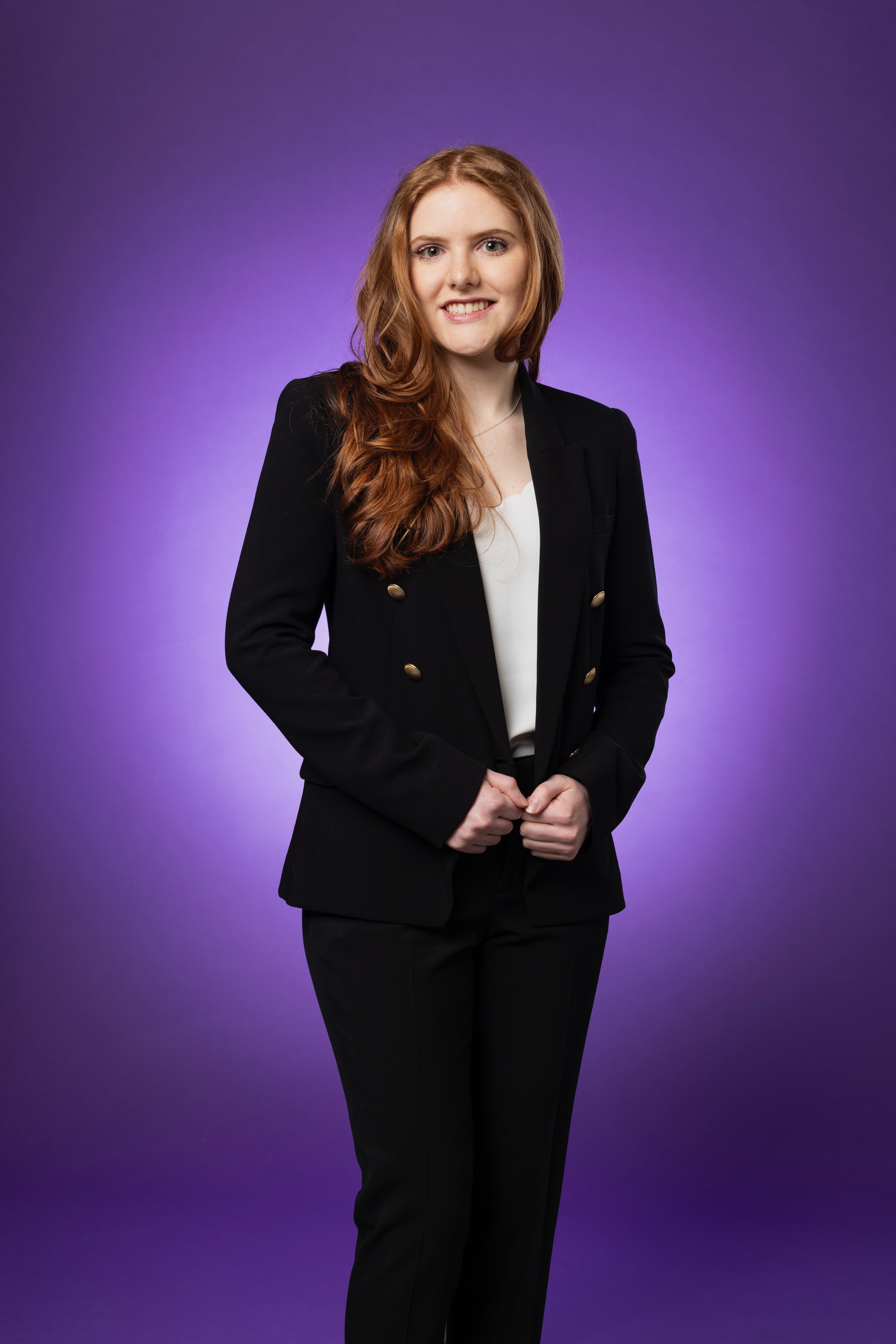
Lauren Ellis Husky 100 headshot.
As a teen exploring Washington’s beaches and forests, Lauren Ellis (B.S. ’26) and her family would pick up trash that others left behind.
Several years later, this experience is still shaping her career. “It sparked my curiosity about the limitations of recycling and why so much waste ends up outside of proper disposal systems,” Ellis says.
Now, as a graduating senior in Chemical Engineering at the University of Washington, Ellis studies methods to improve plastic recycling. For this research and her impressive list of extra curriculars, Ellis was named to the Husky 100. This prestigious award honors 100 students across the University of Washington who are making the most of their time at UW.
A spark for STEM
Yet Ellis’ undergraduate journey started elsewhere — at Bellevue College, on the eastside of Lake Washington. There, she took a physics class, a chemistry class and several math classes. Though in elementary and high school Ellis didn’t think she was good at science, these classes sparked her interest in STEM and her confidence to pursue it.
“I loved all of these classes, and I thought, ‘How can I do all of this?’” Ellis recalls. “I went to Google and searched for a major that combined all three topics, and I found chemical engineering.” In learning more about chemical engineering, Ellis knew this was the major she wanted to pursue.
Becoming a Husky
UW’s strong engineering program was a major draw for Ellis to transfer here. “UW’s reputation, along with its access to research opportunities and strong industry connections, made it an ideal place for me to pursue my education,” she says.
She also was connected to campus on a personal level. Her mother attended UW; and, growing up in Issaquah, UW felt close to home. Her first visit to UW was in middle school, when her class celebrated their eighth-grade graduation on the Seattle campus.
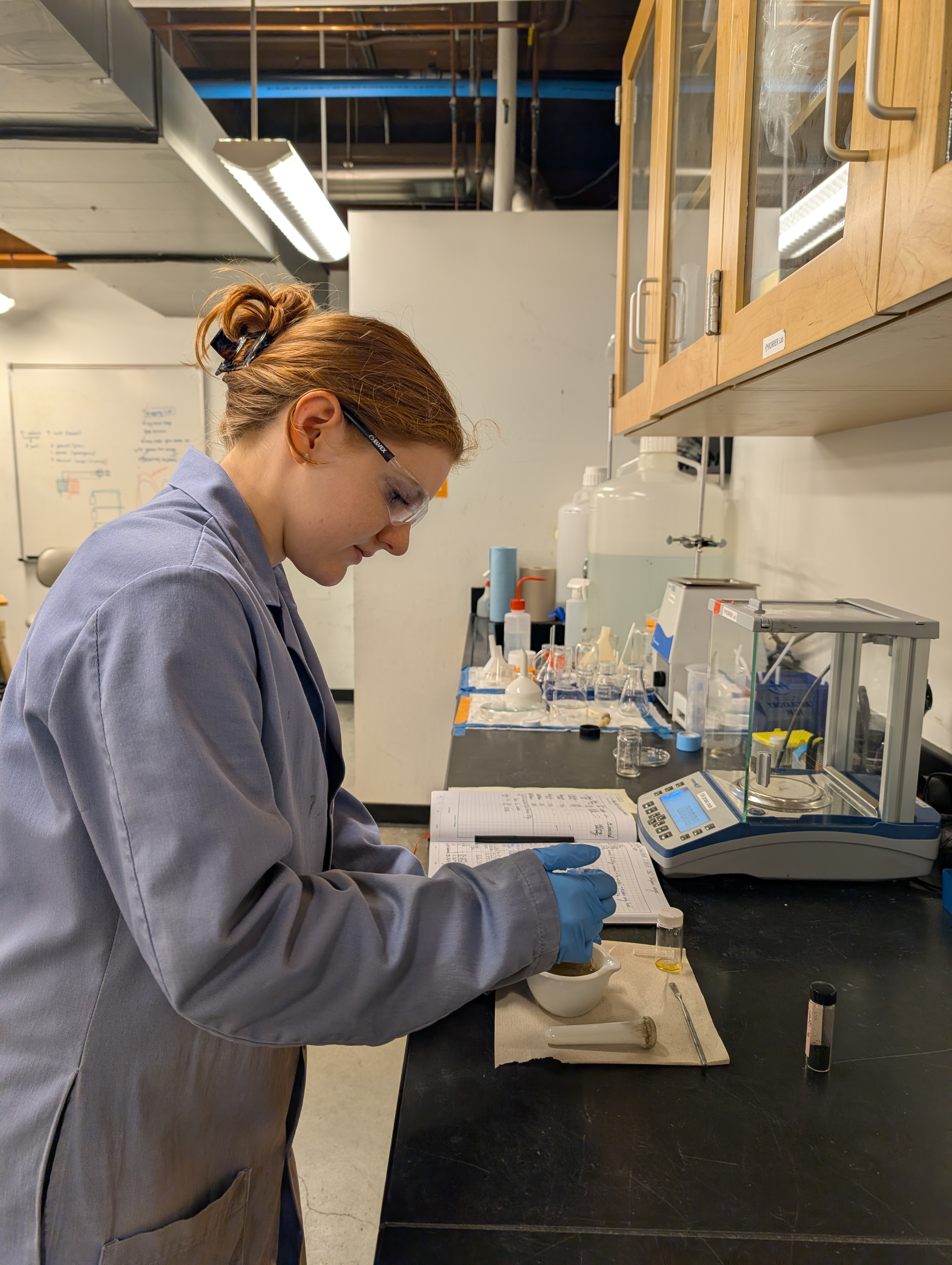
Ellis synthesizes her catalyst in the Rorrer Lab.
So, after completing two years at Bellevue, Ellis transferred to the University of Washington in the fall of 2023. The following spring, Ellis declared a chemical engineering major.
“Starting at Bellevue College and then transitioning to UW was really exciting,” Ellis says. Bellevue College was mostly virtual following the COVID-19 pandemic, and Ellis missed attending classes in-person. “Being able to talk to people and ask questions motivated me to be really active at UW,” she says. “It’s pretty nerdy, but I found so much joy in being in class, learning from others, meeting people during office hours, and having the opportunity to hear professors talk about topics they were passionate about.”
Ellis’ resume captures that excitement. After transferring to chemical engineering, she became an undergraduate researcher in the Rorrer Lab. Not long after, she became involved in the UW’s student chapter of the American Institute of Chemical Engineering (AIChE) and organized the departments first-ever Chemical Engineering Undergraduate Poster Symposium. When Ellis heard that there was student interest in bringing back ChemE Car, she decided to make it happen. (The ChemE Car competition, held at the annual AIChE Conference, tasks students with developing a car powered by a chemical engineering source).
“I had no knowledge or experience, but I was enthusiastic,” she says. “I got a bunch of people together and said, ‘we’re going to do this.’ None of us knew how the organization ran, but we learned together. It was a collaborative effort.”
Ellis became AIChE President in her senior year, and this spring led the ChemE Car Team to a first-place win in the poster competition at AIChE regionals. The team will go onto compete at the national competition this fall.
Dr. Julie Rorrer, faculty advisor for AIChE, recalls how difficult it was to get these student organizations up and running again. “Lauren was a catalyst for revitalizing both organizations," she says. “Her initiative and professionalism have measurably strengthened both the department’s community and its culture of professional development. These programs not only increase belonging and support in the department but create a culture that sustains growth by uplifting the next generation of leaders."
Pushing through imposter syndrome
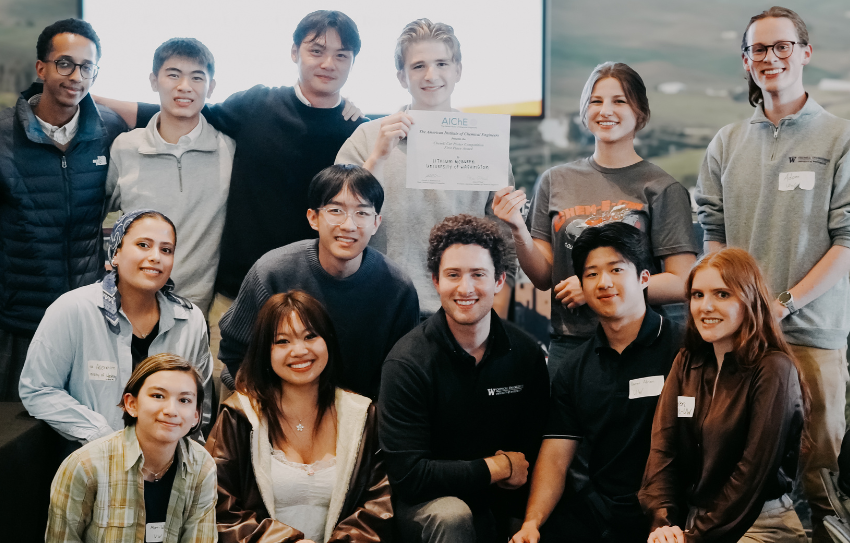
Ellis, far right in front, with the Chem-E Car Team after their win at the AIChE PNW Regional Conference in Pullman, Wash.
Though Ellis was enthusiastic coming into the department, she says behind that enthusiasm was some self-doubt and imposter syndrome.
“When I tell people that I didn’t do these types of STEM activities in high school, they’re usually surprised,” she says. Many of her peers grew up immersed in STEM activities like robotics clubs, but Ellis felt new to the world of STEM.
Ellis has channeled these feelings of imposter syndrome into mentoring new undergraduate students coming into the department. Working with Women in Chemical Engineering, she implemented a peer mentorship program that has brought together more than 100 students. Ellis herself is in a peer mentor group with a sophomore and junior ChemE student. “It’s been really exciting to share my experience in the department and help them figure out how to navigate coursework, develop good study habits and build a sense of belonging in the ChemE Department,” she says. “Giving advice and seeing how it’s taken and applied by others has been really rewarding.”
Ellis has also found strong mentors in the ChemE Department. “Dr. Rorrer in particular has been a really strong presence in my undergrad experience, from helping me revitalize AIChE to shaping my research,” she says. “Her guidance has meant so much to me.”
Catalyzing the future
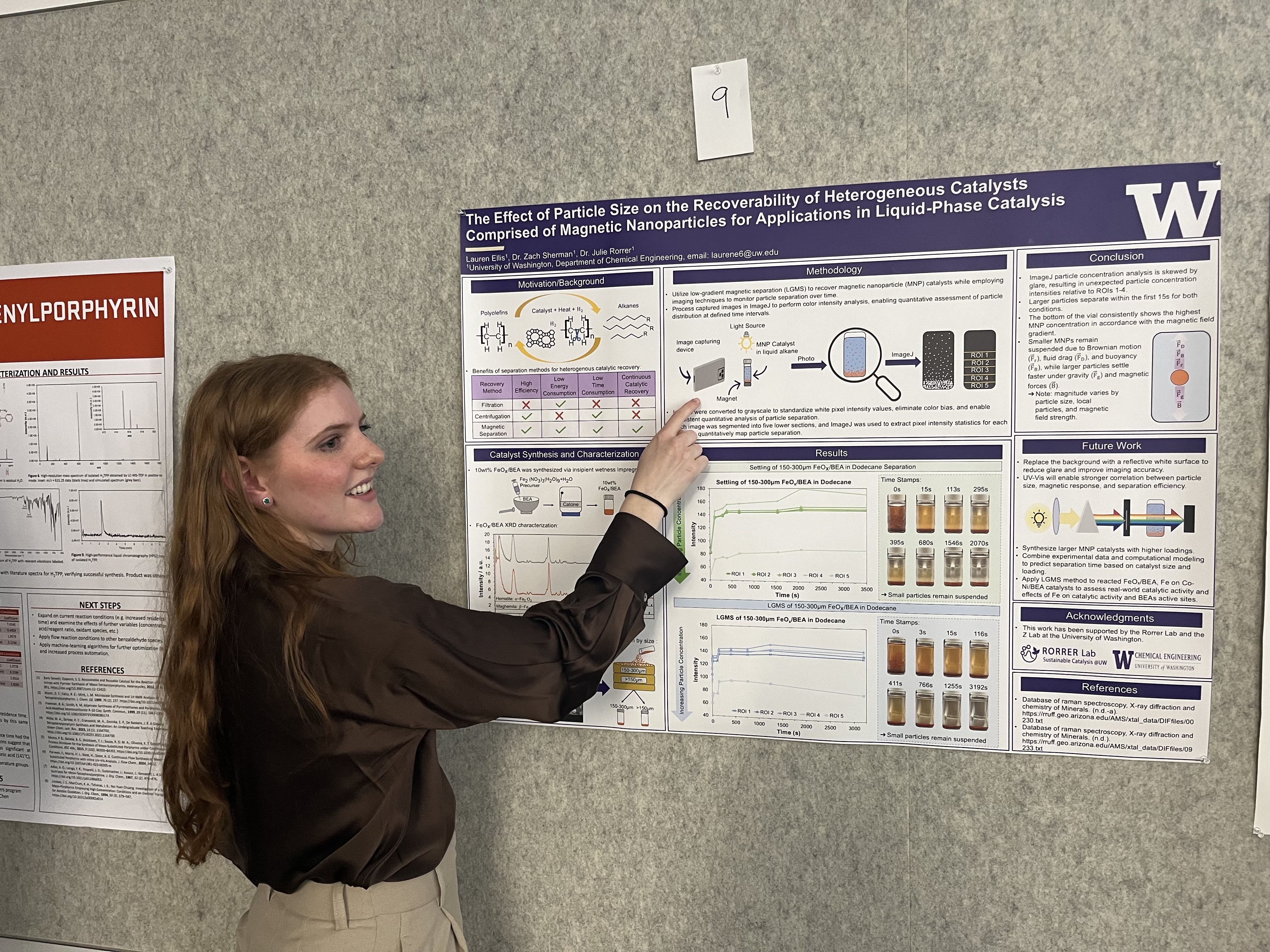
Ellis discusses her research at the AIChE PNW Regional Conference.
Ellis’ research in the Rorrer Lab is another way she has distinguished herself in the ChemE Department. Her research studies how to use catalysts — materials that help speed up chemical reactions — to improve plastic recycling.
“In our lab, we use catalysts to break down plastic waste into smaller molecules that can be reused to make new materials or fuels,” Ellis says. “My work looks at how to recover these catalysts after the reaction so they can be reused instead of becoming an environmental contaminant.”
Ellis uses magnets to separate the catalysts from the liquid reaction products, and studies how efficiently the process of removing catalysts works. “By improving catalyst recovery, my research aims to make plastic recycling more efficient, reduce environmental contamination from metals, and support more sustainable manufacturing processes,” she says.
Ellis has received many awards and recognitions for her research, including recognition from the UW’s Population Health Initiative, an award from the UW Clean Energy Institute, and scholarships from the Solid Waste Association of North America and the Renewable Energy Scholarship Foundation.
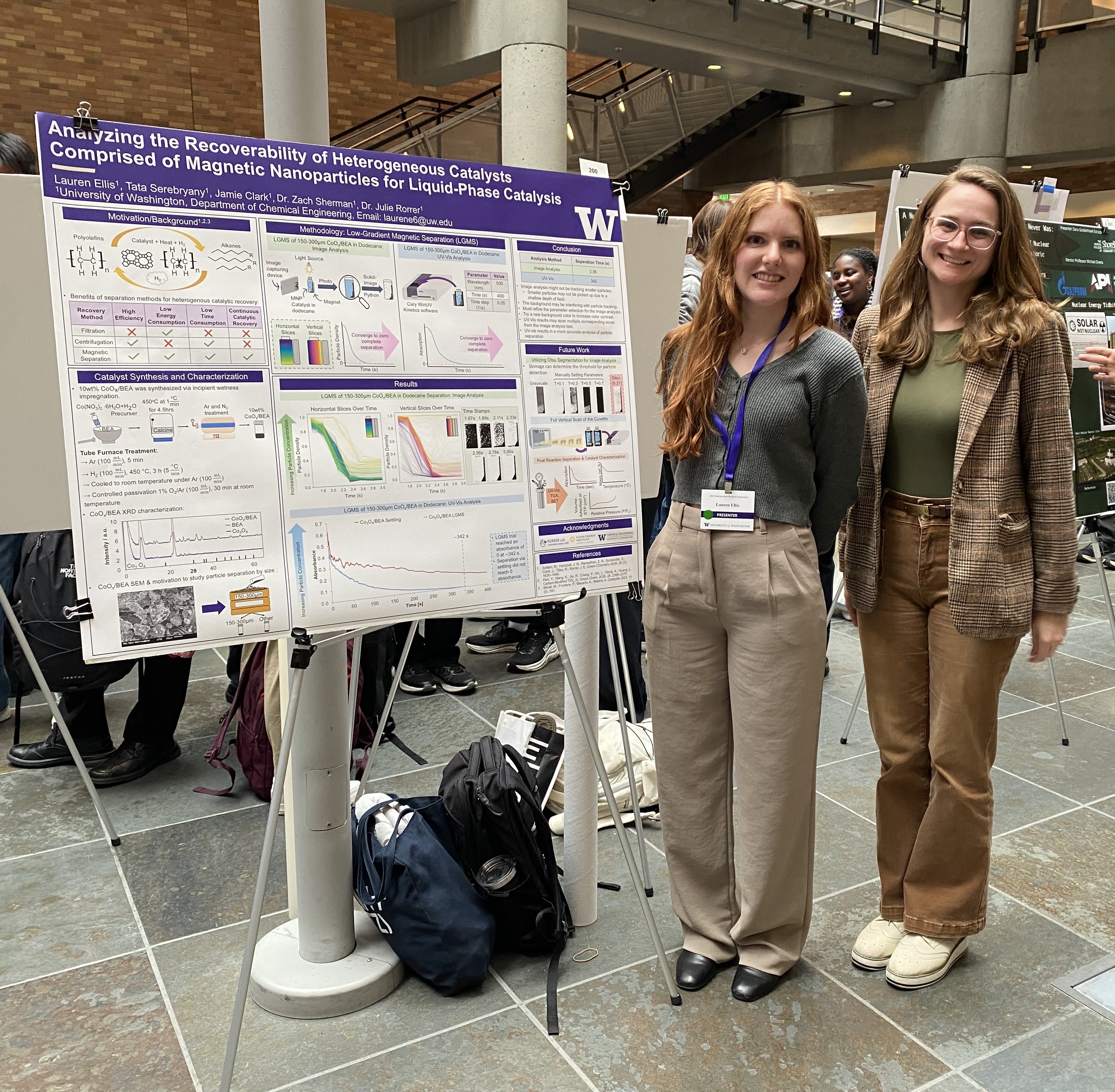
Ellis, left, stands with Rorrer in front of Ellis’ poster at the 2026 Undergraduate Research Symposium on the University of Washington campus.
“Lauren is the ultimate doer, and one of the most professional, proactive, responsive, organized and creative undergraduate students I have encountered in my entire academic career,” Rorrer says. “She tackles research challenges at the level we expect of our PhD students, and because of this, she has earned national recognition for her research efforts. Lauren was such a sought-after candidate for PhD programs that I had multiple professors at institutions across the country asking me, “what can we do to get Lauren to come to our program?”
Ultimately, Ellis chose University of Wisconsin–Madison for her doctoral degree. She will start there this fall and continue her work in catalysis. She has received a scholarship from the Graduate Engineering Research Scholars program, which will fund up to two years of her graduate studies. As a Scholar, she will also take part in community engagement and undergraduate mentorship.
“What I’m hoping to do is to not only mentor undergrads who feel that imposter syndrome that I went through coming into the department; I also want to do K-12 outreach and talk to young students,” she says. Ellis knows there are young students out there who think STEM is cool, but don’t believe they’re smart enough to pursue it. She wants to be the person who tells them you are smart enough.
“Everyone can pursue STEM,” Ellis says. “You just need a passion for it. I think it would have been really beneficial if I had someone growing up who told me I could do this. So I’d like to be that person for someone else.”
Originally published June 23, 2026