
The Department of Chemical Engineering welcomed Dr. Frank S. Bates, Regents professor and member of the Chemical Engineering and Materials Science department at the University of Minnesota, for the Chair’s Distinguished Lecture last week.
Bates is one of the most influential polymer scientists and chemical engineers of the past four decades. Department Chair Elizabeth Nance says he was selected for this lecture based on his illustrious career, which has combined fundamental discoveries in polymer physics with practical advances that have shaped materials science, chemical engineering and industrial polymer technology.
Drawing on cutting-edge synthetic chemistry, Bates’ research seeks to better understand the structure and properties of polymers of different molecular architectures, including homopolymers and block copolymers. His most recent work is focused on plastics recycling; polymers with complex ordering, such as quasicrystals; and medical applications of amphiphilic bottlebrush block copolymers.
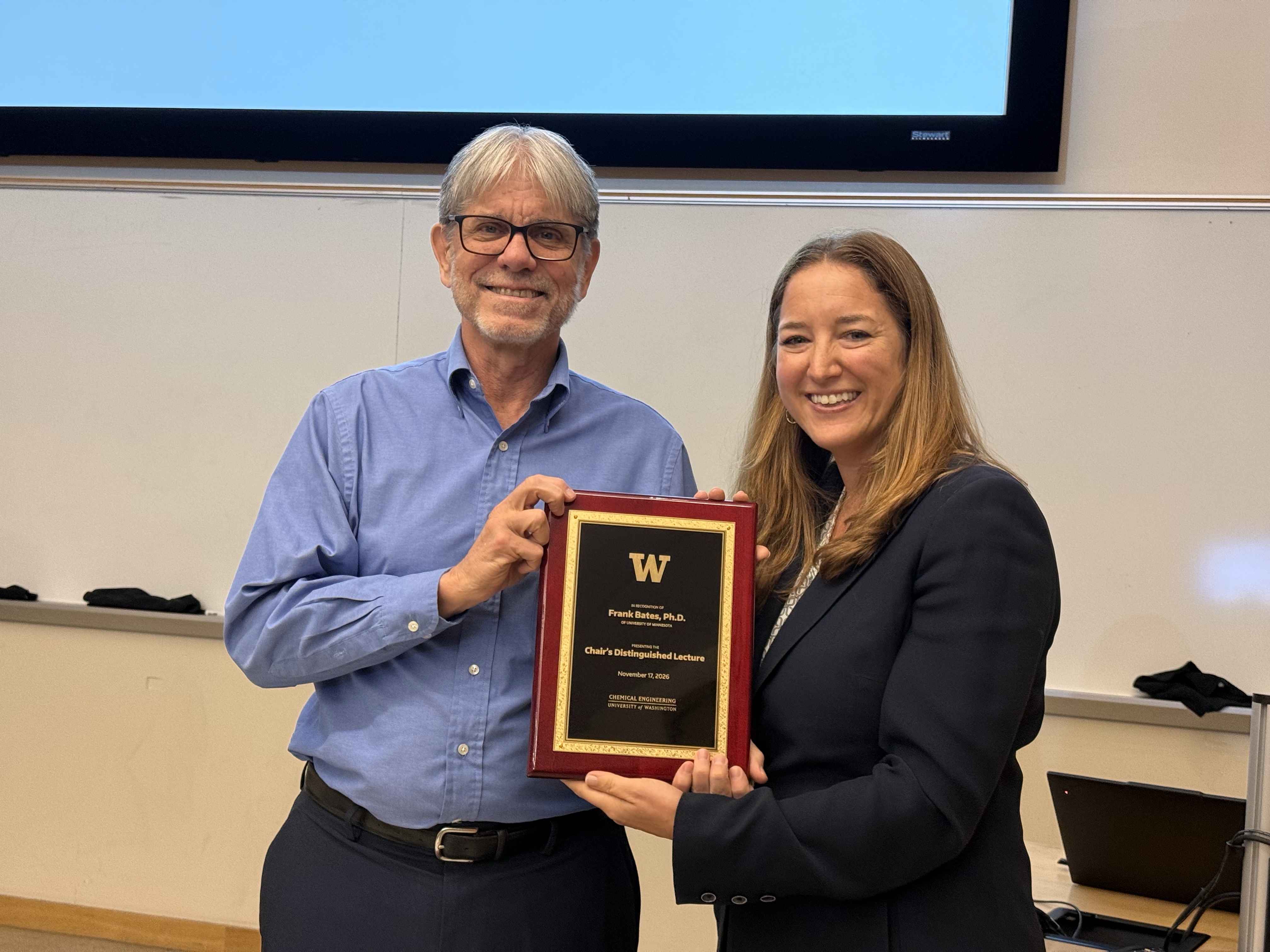
Frank Bates, left, accepts a plaque from Elizabeth Nance following his lecture.
Bates’ lecture drew on his recent research on treatments for Duchenne muscular dystrophy (DMD), a rare, progressive genetic disorder that primarily affects boys and appears in approximately 3,600 newborns annually. He discussed the results of a 2025 study, conducted by Bates and co-authors at University of Minnesota’s College of Science and Engineering and the Medical School, which demonstrated that delivery of the bottlebrush block copolymer can prevent symptom onset of DMD in mice.
This discovery “has the potential to alleviate the devastating consequences of Duchenne muscular dystrophy,” Bates says, and “demonstrates how innovative polymer science can catalyze medical advances.”
Bates received a bachelor's degree in mathematics from SUNY Albany and his Doctor of Science in Chemical Engineering from MIT. From 1982 to 1989 Bates worked at Bell laboratories. He joined the faculty at the University of Minnesota in 1989 and served as Department Head of Chemical Engineering and Materials Science from 1999 to 2014. He has co-founded two companies: Valerian Materials, in 2015, and Elymus, in 2025. He is a member of the US National Academy of Engineering and National Academy of Sciences, and the American Academy of Arts and Sciences.
Originally published November 23, 2026