
A new tool for the biologist’s toolkit.

Long Tran.
That’s what Long Tran is unveiling with NovoTags, a set of imaging tools he has developed alongside his advisor Dr. David Baker and collaborators from the European Molecular Biology Laboratory in Heidelberg, Germany and the Howard Hughes Medical Institute in Virgina.
NovoTags are designed proteins that can illuminate (or “tag”) specific areas of cells so they can be better studied under a microscope. While other imaging methods exist, NovoTags address several limitations of those methods.
The research behind NovoTags was published in Science earlier this month. Tran, a fourth-year student in Chemical Engineering, is the lead author on the paper, titled De novo design of orthogonal far-red, orange, and green fluorophore-binding proteins for multiplexed imaging. It is one of the first studies to describe the use of protein design for multiplexed fluorescence imaging.
"We hope these designed proteins become go-to tags for everyday microscopy,” Tran, a student in the Baker Lab, says. “Ultimately, we hope these tools become as routine and widely adopted among imaging biologists as HaloTag and SNAP-tag — established labeling systems that have become part of the field’s standard toolkit.”
The building blocks of NovoTag
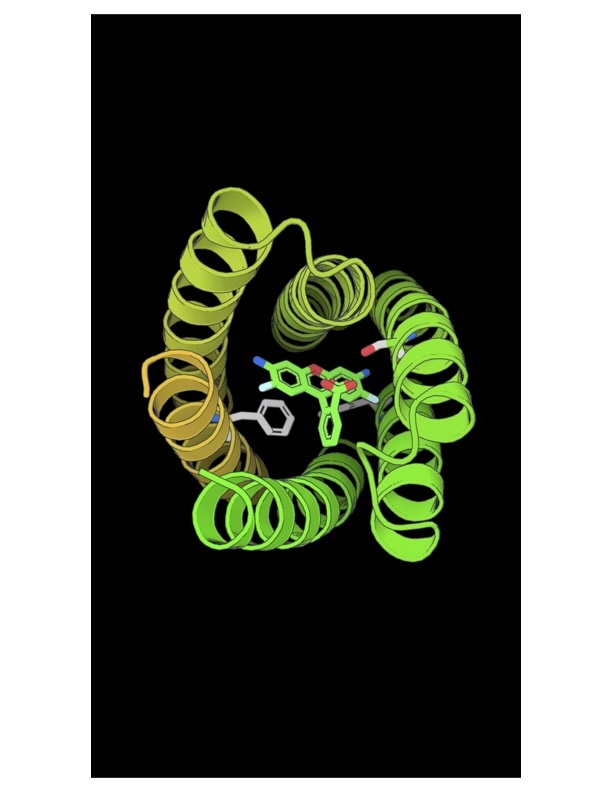
An illustration of NovoTags.
NovoTags combine the strengths of fluorescent proteins, such as the green fluorescent protein, and small molecule dyes (also known as fluorophores).
The green fluorescent protein occurs naturally in jellyfish and was first isolated in the 1960s at UW’s Friday Harbor Labs on San Juan Island. Later, scientists engineered fluorescent proteins in red and yellow. In the lab, these fluorescent proteins function similarly to NovoTags — they can be attached to a molecule of interest and illuminate said molecule under a microscope.
This method has its limitations, however. Most natural fluorescent proteins are not bright enough for super-resolution microscopy methods. They also are not sufficiently photostable, meaning they will bleach after long periods under a microscope. Thus, biologists need new imaging tools that can keep pace with modern technologies.
Small molecule dyes, like those developed by the Lavis Lab at the Howard Hughes Medical Institute, addressed some of the limitations of natural fluorescent proteins. They have the advantages of being very bright and holding their color under a laser. They also can be tuned to multiple colors across the spectrum. However, on their own, they cannot attach to an area of interest within a cell.
NovoTags address the need for more advanced imaging tools by designing a protein specifically to bind to the small molecule dyes. These proteins can be easily attached to specific parts of the cell, such as proteins or organelles, that a scientist wants to study. When these elements are in place, the dyes can be introduced into cells and will illuminate the areas of interest under microscopy.
Especially when combined with other tagging technologies, NovoTags will “drastically increase the options for illuminating multiple areas of a cell simultaneously”, says Steffen Klein, a co-lead author and a postdoctoral fellow at European Molecular Biology Lab Heidelberg. This will “allow us to study complex biological processes within a cell that involve many different proteins,” he adds.
Next steps for NovoTag
The author team is committed to making this work accessible. They have published the sequences of the NovoTag proteins, enabling others to apply this technology in their own research. The small molecule-based dyes are also free to request from the Lavis Lab website.
"We want the entire academic community to be able to use these tools freely and easily," Tran says. "Our philosophy is simple: keep the science open and accessible to everyone."
Tran and the author team are already building on this research. They plan to expand the available colors of NovoTag from three to 10. This would help meet biologists’ demands for more colors, allowing them to visualize more structures simultaneously. Long-term, the team is interested in developing an iteration of NovoTags that illuminates conditionally, only when it binds to an area of interest.
Ultimately, the spirit of NovoTags and the author team is that of collaboration — between people, labs and institutions. NovoTags wouldn’t have been possible without the building blocks that formed it nor without the collective efforts of its authors.
“I’m very grateful to be part of such a collaborative project,” Tran says. “It’s incredibly rewarding to see our collective efforts come together, and we’re excited to finally share this toolkit with the broader research community."
Originally published September 14, 2026