
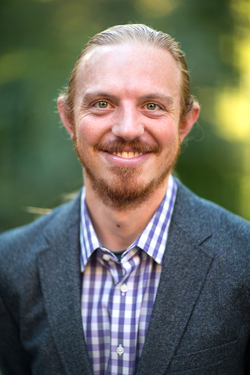
Dr. Cole DeForest, Weyerhaeuser endowed professor of Chemical Engineering and Bioengineering, has received an additional five-years of support from the National Institutes of Health (NIH). The grant will support the continuation of his lab’s work in developing methods for studying human development and disease progression in four dimensions, examining changes in both 3D space and time.
As a faculty member in the Institute for Stem Cell and Regenerative Medicine, DeForest and his research group partner with biologists and disease pathologists to probe and direct critical biological processes that occur in the body, but in simplified models they create in a lab setting. This work was first funded by a Maximizing Investigator’s Research Award (MIRA) from the National Institute of Health in 2020. The MIRA is particularly unique because it funds “people, not projects” – meaning it allows investigators to pursue ideas as they emerge rather than being tied to fixed research aims.
The MIRA renewal marks “the continuation of the most impactful and comprehensive funding our lab has received,” DeForest says. “Having this vote of confidence for a second five-year term allows our lab to continue pushing the boundaries of how we study and control living systems in 4D.”
This work has incredible potential to support medical progress. This work will “fundamentally transform our knowledge of basic cell physiology,” DeForest says, thereby “laying the foundation for advances in disease diagnosis, treatment, and prevention.”
DeForest is one of two faculty members in Chemical Engineering to receive significant funding from the National Institute of Health this spring. Dr. Jorge Marchand recently received a MIRA for his work growing the “biocatalytic toolkit” for therapeutics.
Originally published July 27, 2026