
As described by Benjamin Hornburg, Lilo Pozzo and Zachary Sherman
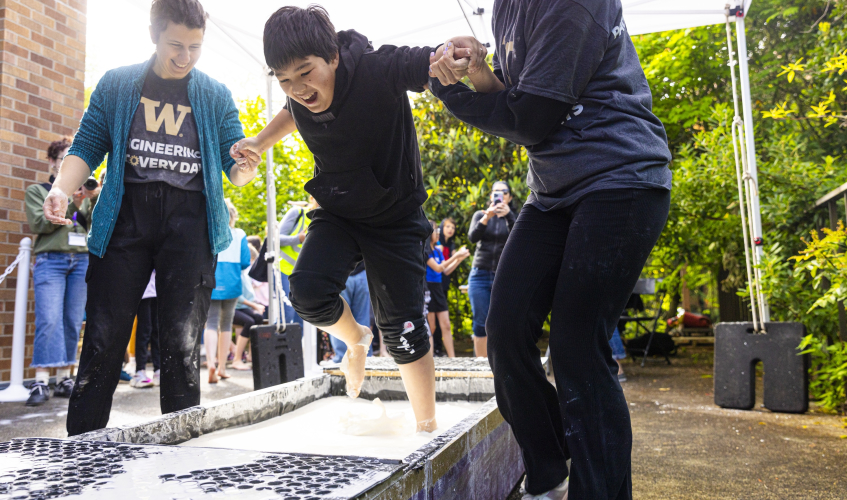
Wanna know how we create the experience of “walking on water” for students joining us at Discovery Days? It takes dedication, innovation, and a LOT of cornstarch.
Discovery Days is a two-day event that invites middle school students to UW campus to experience hands-on, engaging exhibits related to engineering.
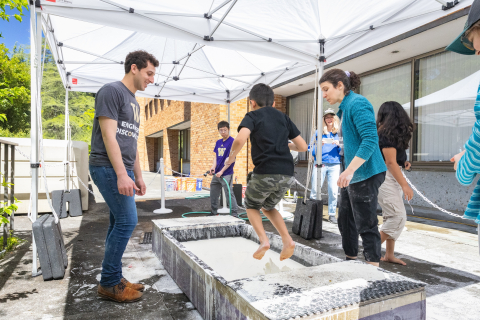
Walk on Water, one of ChemE’s most popular (and high-energy) exhibits, invites students to run across the surface of a 10-foot pool of Oobleck (a mixture of cornstarch and water). To students standing on the starting line, It looks like they will fall right into this pool of sloshing, milky liquid — but, surprise! When they step onto the pool, the surface is actually hard!
So, how does Walk on Water work? The science of this exhibit really comes down to the science of Oobleck. Dry cornstarch is a powder made up of individual particles, each one roughly one-tenth the thickness of a human hair. When mixed into water, these individual particles are evenly distributed and suspended (called a “colloidal suspension”).
At rest, the Oobleck appears to be a typical liquid — it sloshes around, its surface ripples. But when it’s disturbed (for example, by someone stirring or mixing it), Oobleck behaves very differently from a typical liquid.
How Oobleck responds to a disturbance depends on how quickly and forcefully it is touched. If you slowly stick your hand into the Oobleck and gently swish it around, the Oobleck will remain liquid-like. Why? Because those suspended particles of cornstarch are sliding slowly past one another, rather than bumping into each other. As these particles slide slowly past each other, the liquid readily flows.
But what if you stir the liquid very quickly, or jump on the surface, or even try to run across it? In this case, the suspended particles move very quickly. They do not slide past each other — instead, they collide into each other, and continue to collide into each other as long as the strong force is applied. We call this phenomenon “shear jamming,” and it makes the Oobleck act more like a solid. So solid, in fact, you could run across its surface. (When students experience the joy of running across our pool of Oobleck, we call that “shear elation!").
However, if you're trying to "walk on water," you can't get too comfortable. As soon as the strong force of your feet slows down or is removed, the cornstarch particles stop colliding, returning the Oobleck to a liquid-like state. That means if you try to stand on our pool of Oobleck, instead of running across it, you will slowly sink into the mixture.
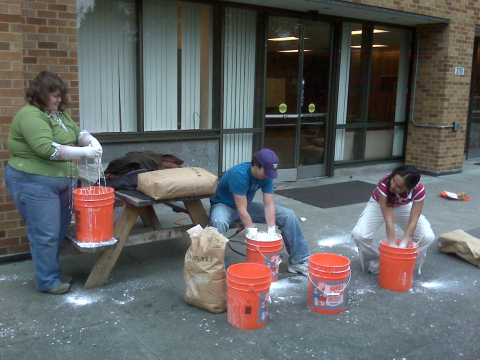
For the first Discovery Days in 2008, all of the Oobleck for Walk on Water was mixed by hand.
Whether you run or sink into the Oobleck, you will be in good company. Since the exhibit first debuted in 2008, thousands of students have tried Walk on Water. And many ChemE students, staff and faculty have shaped it into the joyful, messy experience it is today. For our very first exhibit, then-PhD Student Kathleen Weigandt figured out the exact ratio of cornstarch to water to create the Oobleck. Dr. Lilo Pozzo designed the original container for the Oobleck and built it with the students in the ChemE student shop. Our students figured out where to procure 400 pounds of cornstarch, and hand-mixed the massive container of Oobleck for the exhibit.
We’ve introduced several updates and innovations since that first exhibit. Student volunteers were especially happy when the Sherman Lab brought in a cement mixer to make the Oobleck — meaning it no longer needs to be mixed entirely by hand. This year, we’re debuting a new, longer container that will double the distance the participants get to run, jump and walk across the “water.” We hope that doubling the distance will double the fun, and for many more years to come!
Originally published April 30, 2026