December 10, 2025
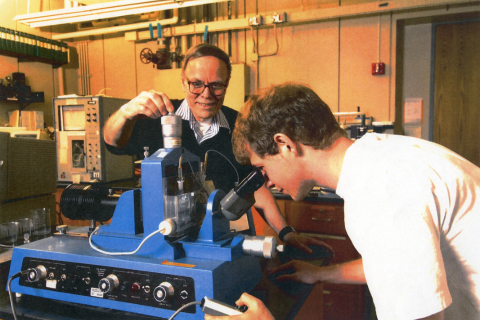
Photo provided by John Berg.
Professor John C. Berg’s unique surface and colloids lab makes the University of Washington’s chemical engineering education stand out. This story summarizes the history of Berg’s career and contributions to the department in his 61 years of service.
Identifying a fundamental gap
On top of being a full-time professor, Berg was an avid industry consultant throughout most of his career. Starting in the late 1960s major manufacturing companies, like 3M and Proctor and Gamble among others, invited him to their facilities. His job was to assess how they could make improvements to chemical processes like coating, adhesion, sedimentation, water-proofing, and a range of challenges in the area of surface and colloid science. While able to offer help with these issues, Berg realized that none of these topics were being taught in his students’ classes.
At that time, he knew of only a few institutions offering coursework to meet these specific industry demands. It became clear that this key subject area of surface and colloid science was largely missing from the chemical engineering curriculum.
Starting from scratch
Determined to meet this deficiency, Berg took it upon himself to become a surface and colloids expert. He conducted extensive self-study and consulted with industry professionals that were more familiar with the topic than he was at the time. A colloids lab course being offered at Carnegie Institute of Technology, now known as Carnegie Mellon University, was extremely beneficial in informing his work to develop his own. Research conducted within his lab at the UW was directed into these industry-critical focus areas, and helped to inform his course material.
In the 1980s, Berg launched his new interfacial and colloid science lecture and lab course as an elective. He offered an additional professional course variation for industry engineers over one week during the summer.
“It was sort of an experiment,” he said, “I got a lot of valuable feedback from teaching the course in both formats, for two very different student audience groups.”
The experiment was an indisputable success, and the lecture-lab course continued to evolve over the following decades. In that time, Berg had the opportunity to travel across the country and even internationally. He brought his mastery of surface and colloid science and his lab teachings into industry settings, and provided lectures and demonstrations on site. He also invited industry engineers into his classroom to perform instrument demonstrations.
Raising the bar in the classroom
The surface and colloid science course has been a core requirement of UW ChemE’s undergraduate curriculum since 2009. UW ChemE is one of only a few programs that not only requires fundamental colloids education at the undergraduate level, but that offers a lab component to the course as well. Several students, including graduate students who take the course as an elective, have come to the UW for ChemE’s academic programs because of John Berg, his research lab and his nationally recognized expertise.
“[His class was] hands-down the best class I’ve ever taken, taught by the best teacher I’ve ever had,” says Jill Seebergh, National Academy of Engineering member and ChemE Ph.D. alumna from Berg’s research program, “The principles of surface and colloid science that I learned in the classroom and applied in the laboratory prepared me beautifully for my first post-Ph.D. job at 3M, and then became the foundation for success in my long career in coatings research and development at Boeing.”
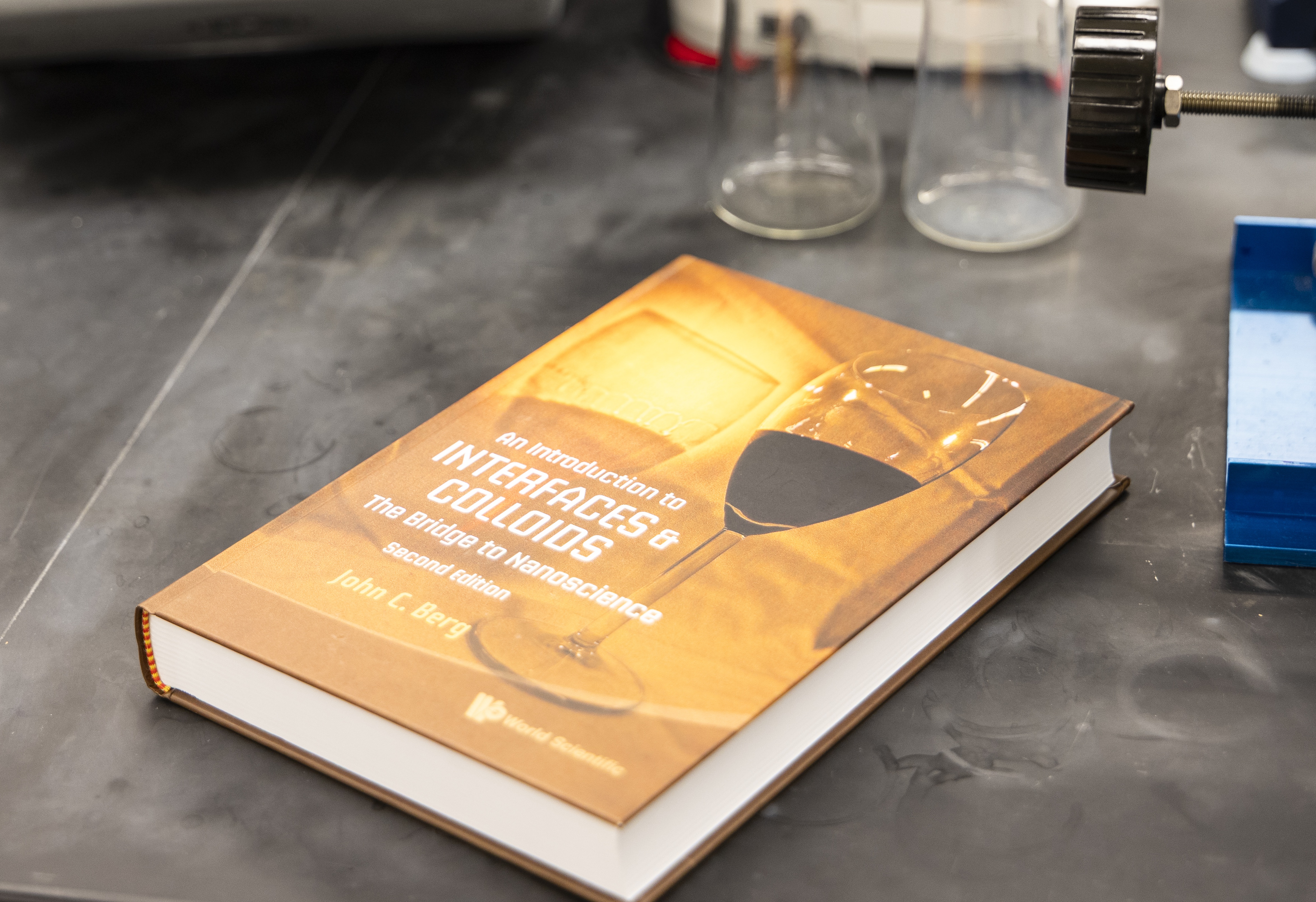
The current edition of Berg's textbook. Photo by Dennis Wise.
Berg published the first edition of his textbook, An Introduction to Interfaces and Colloids: The Bridge to Nanoscience, in 2010. The second edition was released in 2024, and is now used by over 100 universities as the required textbook for their colloids courses.
Aside from his subject matter expertise, ChemE alumni routinely comment on the privilege it was to have been taught by John Berg because of his enthusiasm, encouragement, and his boundless capacity to champion for his students.
Mary Armstrong (ChemE B.S. ‘79) credits Berg for her consideration to apply for graduate school, and remembers how he was able to really bring chemical engineering to life.
“John’s enthusiasm for chemical engineering courses was catching. He could explain complex principles in an understandable way and tie them to real-life applications. I was never afraid to ask a question in class or during his office hours, because of the way John responded. He had a very high standard for his courses and a very high teaching standard for himself.”
Maintaining and continually upgrading the course has been a challenge, with an evolving repertoire of 20 experiments demanding a broad range of instrumentation and techniques. Berg’s long- standing industry work and his commitment to nurturing relationships with industry and decades of alumni have helped to maintain ongoing funding for the operation of the Surface & Colloids Lab in Benson Hall.
Handing off a legacy
Now, after being a professor of chemical engineering at the UW longer than Benson Hall has existed, John Berg is preparing to retire from the full-time faculty role he has held for over six decades. Throughout that time, he has graduated 57 Ph.D. students and 55 master’s students from his research lab. He intends to continue teaching the surface and colloids lab and lecture in the spring of 2026, as a part-time professor.
Berg’s contributions to the UW, to the Department of Chemical Engineering, and to the broader world of surface and colloid science and education have not gone unrecognized throughout his tenure. He received a Guggenheim Fellowship in 1974, and was invited to be a guest professor at the Federal Institute of Technology (ETH) in Zürich, Switzerland. In 1984, he was honored with the Alpha Chi Sigma Award for Chemical Engineering for his outstanding achievements in chemical engineering research.
A 50th anniversary event hosted at the UW in 2014 brought together five decades of ChemE alumni to celebrate Berg, and he was honored with the UW Distinguished Teaching Legacy Award in 2023. In June of last year, the American Chemical Society Surface and Colloid Science Symposium was dedicated to him.
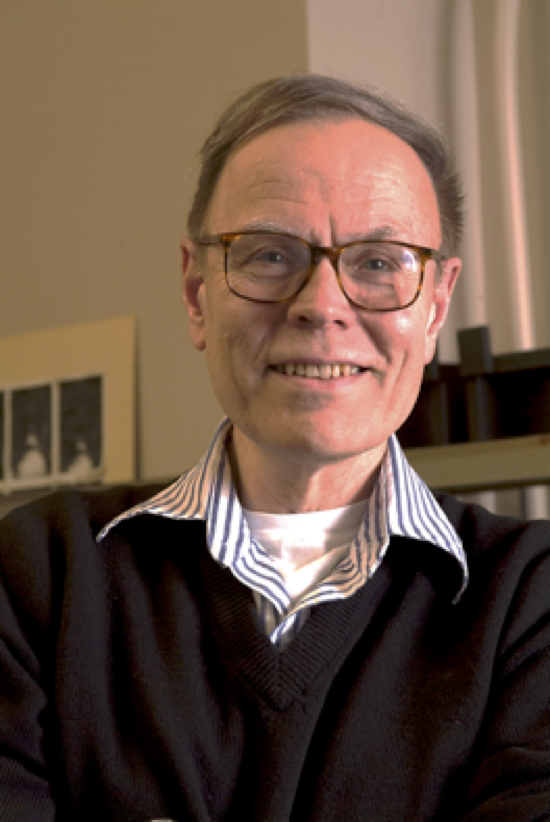
“This has been a labor of love for me, and in the hope that the program will continue following my retirement, I have endowed a Teaching Assistant Professorship in Interfacial and Colloid Science in the Department of Chemical Engineering.”